
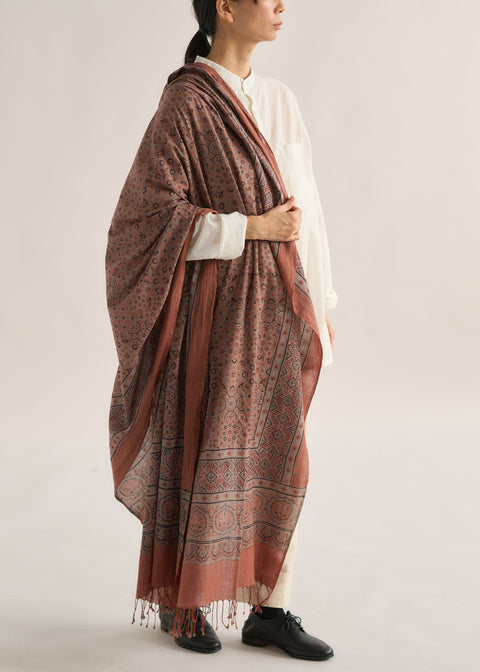
Sufiyan Ismail Khatri 500-Count Miniature Shawl
¥93,500
Product Description
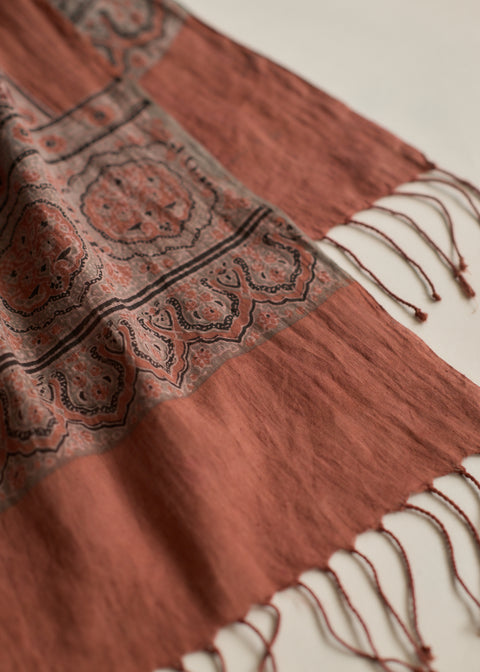
This shawl was made in the workshop of Sufiyan Ismail Khatri, a leading expert in Ajrakh dyeing.
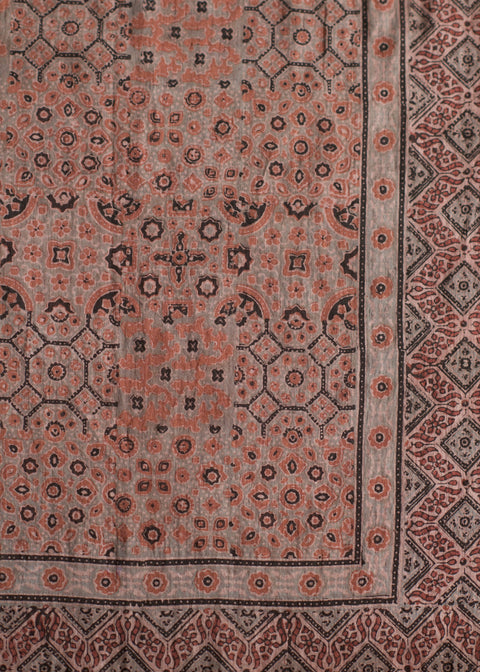
Ajrakh is a traditional dyed fabric passed down by the Khatri community, who migrated from Sindh to Kutch in Pakistan about 400 years ago. Many of its designs feature symbols of stars, and are made using resist dyeing and printing techniques.
Among them, this stole, named Miniature (meaning "fine"), uses a woodblock that is smaller than usual, and the pattern is therefore finer.
The rich colors of natural dyes make the world even more emotionally rich.
The fabric we use is 500 count hand-spun and hand-woven, befitting the value of the work.
For reference, Kyarico's Usuri Khadi uses 100 count yarn, and Muslin D uses 300 count yarn. 500 count is an even finer count, and in principle 500 count fabric itself is very rare and difficult to obtain.
The roughness of the process is sometimes part of Ajrak's charm, but in the case of this 500 count, it is so delicate and expensive that processes such as washing are carried out carefully and over several times the usual time.
This is a sophisticated piece that brings new history to the ancient Ajrakh tradition.
size
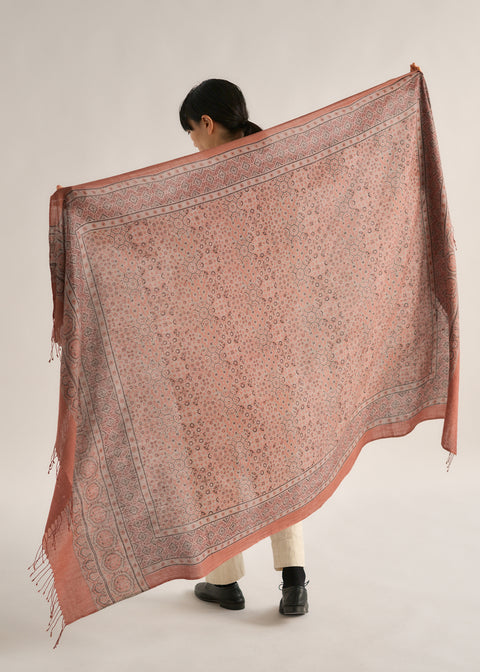
Approximately 118cm x approximately 196cm
*Does not include fringe.
* Size and color may differ from actual product.
raw materials
cotton
Production area
Kutch , Gujarat
How the design works
Designed by artisans and production groups
Sufiyan Ismail khatri
spinning thread
Hand-spun by Ambirkar
Weaving
Handloom plain weave
dyed
Ajrakh dye ( Textile printing using traditional dyes )
Indigo, Lacquer, Iron
Before you purchase
* This product is also carried in the stores, so it may occasionally be sold out at the time of your order through the website. Unfortunately if that the product is out of stock after you placing the order, we will contact you. We appreciate your understanding.
* Hand-spun yarn is mainly made by women in the village using an efficient modern spinning wheel called an “Amber Charka.” When the yarn breaks, it is spun by hand, resulting in neps, which is a characteristic feature.
* Most of hand-spun and handwoven fabrics are produced in village huts, and as a result, threads or grass may occasionally be mixed in. Additionally, there may be uneven areas, wrinkles, or slight discoloration caused by thread breaks, as well as unavoidable minor stains. Please understand that these are characteristic features of those fabrics.
* Depending on the material, friction during use may cause pilling or fuzziness. Excessive friction or pressure can cause a fabric damage, so please avoid such a situation.
* We use natural or traditional dyes (including synthetic dyes) and dye with the traditional methods. Please note that the color may vary slightly depending on the craftsman's sense and environmental factors. The color will gradually fade with use, giving it a unique patina.
* In case the fabric is dyed using natural and/or dark-colored dyes, please note it may fade or transfer color due to friction, rain, or sweat, etc. Please be careful when wearing light-colored clothing or carrying light-colored bags, or when using them with furniture.